
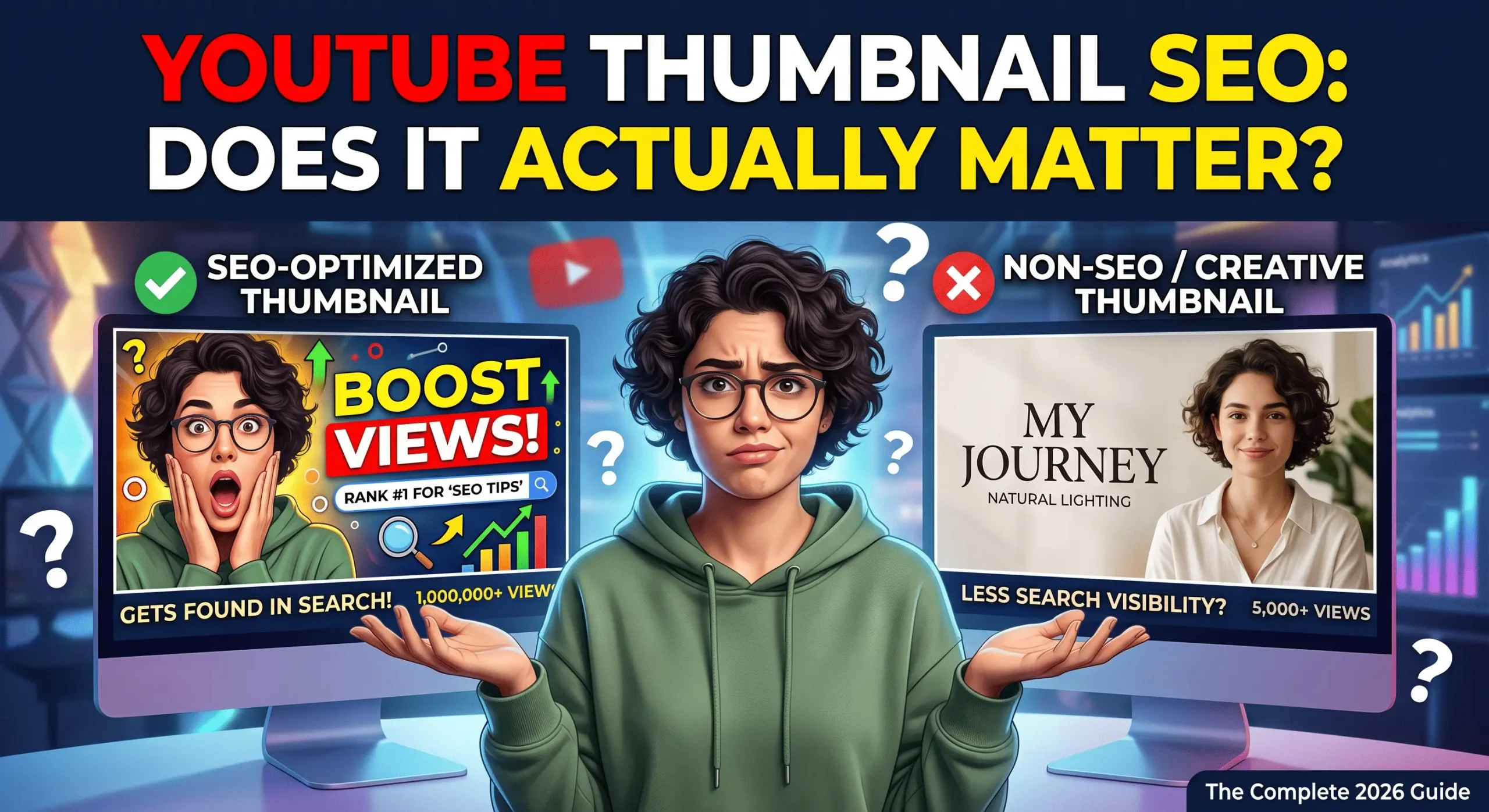
YouTube Thumbnail SEO: Does It Actually Matter in 2026?
When content creators discuss YouTube SEO, the conversation almost always revolves around keyword-rich titles, perfectly optimized descriptions, and strategic tags. But what about the image file itself? Can the actual thumbnail image influence how high your video ranks in YouTube search results?
The short answer is yes, but not in the way most outdated SEO guides claim. The algorithms have evolved significantly, and optimizing your thumbnail in 2026 requires a mix of technical formatting, AI understanding, and human psychology. In this guide, we will break down the reality of YouTube thumbnail SEO, debunk old myths, and show you exactly what matters to the algorithm today.
The File Name Myth: Does “keyword.jpg” Work?
For years, a common SEO “hack” was to rename your raw image file from a generic IMG_1234.jpg to something highly specific like best-workout-routine-for-beginners.jpg before uploading it to YouTube Studio.
Does this actually boost your ranking? The direct algorithmic impact on YouTube search is minimal to nonexistent. YouTube relies on your video’s metadata (title, description, captions) to understand the context, not the file name of your cover image.
However, renaming your files is still considered a best practice for Google Image Search. Videos frequently rank in standard Google searches, and Google’s web crawlers do factor in image file names. So, while it won’t magically make your video go viral on YouTube, proper file naming is a harmless digital hygiene habit that might bring you a slight bump in external traffic.
The Real SEO is CTR (Click-Through Rate)
If you want to understand YouTube SEO, you must understand that the algorithm is designed to follow the audience. YouTube does not rank videos based on how many keywords you stuffed into a box; it ranks videos based on how people react when they see them.
Your thumbnail’s primary SEO function is to generate clicks. If your video ranks #3 for a search term, but your thumbnail is so compelling that it gets more clicks than the videos in the #1 and #2 spots, the algorithm will quickly promote your video to the top. High CTR signals to YouTube that your content is exactly what the searcher was looking for.
To master the psychological triggers and visual hierarchies that drive these massive click-through rates, we highly recommend reading our deep-dive guide on how to design a thumbnail that gets clicks. It covers everything from color theory to the “Rule of Three” that top creators use to dominate search results.
Google’s Vision AI: YouTube Can “Read” Your Images
Here is where thumbnail SEO gets incredibly advanced. YouTube (owned by Google) uses the Cloud Vision API to analyze every frame and image uploaded to its servers. This means the algorithm can literally “see” and “read” your thumbnail.
- Optical Character Recognition (OCR): The AI reads the text placed on your thumbnail. If your video title is about “SEO Tips” but the text on your thumbnail says “Make Money Fast,” the system detects the disconnect, which can negatively impact your relevancy score.
- Object and Emotion Detection: The AI can identify objects (cars, phones, food) and even facial expressions (happiness, shock, sadness). Aligning these detected elements with your video’s metadata reinforces the topical authority of your content.
- SafeSearch Filtering: If the AI detects overly graphic, violent, or misleading imagery, it will suppress your video’s reach, effectively killing its organic SEO potential.
Technical SEO: Size, Resolution, and Cropping
Technical SEO applies to images too. A perfectly designed thumbnail is useless if it is compressed heavily by the platform, appears blurry, or gets cropped awkwardly on mobile devices. A poorly formatted image leads to a lower CTR, which indirectly tanks your ranking.
To ensure your images are technically flawless, crystal clear, and properly proportioned across all devices (from smart TVs to iPhones), you must adhere to the exact YouTube thumbnail sizes and dimensions before exporting your final design.
The Final Verdict
YouTube Thumbnail SEO is very real, but it is driven by user behavior (CTR) and AI image analysis rather than hidden metadata or file names. Focus on creating high-contrast, emotionally engaging images with clear text that accurately represents your content. When you design for the human viewer, the algorithm will naturally reward you.
Frequently Asked Questions
Does the image file name affect YouTube search rankings?
Directly on YouTube, renaming your image file (e.g., keyword.jpg) has little to no impact on your ranking. However, it can slightly help your video surface in Google Image Search, making it a good, yet minor, SEO habit.
Can YouTube read the text on my thumbnail?
Yes. Google’s advanced Vision AI and OCR (Optical Character Recognition) technology scan uploaded images. It is highly recommended that the text on your thumbnail matches the general context and topic of your video’s title and description.
Why did my video’s ranking drop after changing the thumbnail?
If your ranking dropped after a thumbnail change, it is almost certainly because your new design has a lower Click-Through Rate (CTR). The algorithm noticed that fewer people are clicking on your video when it is presented to them, causing it to demote your content in favor of higher-performing videos.